Posts

Showing posts with the label Automation

The Rise of Automation: Revolutionizing Industries and Transforming the Future

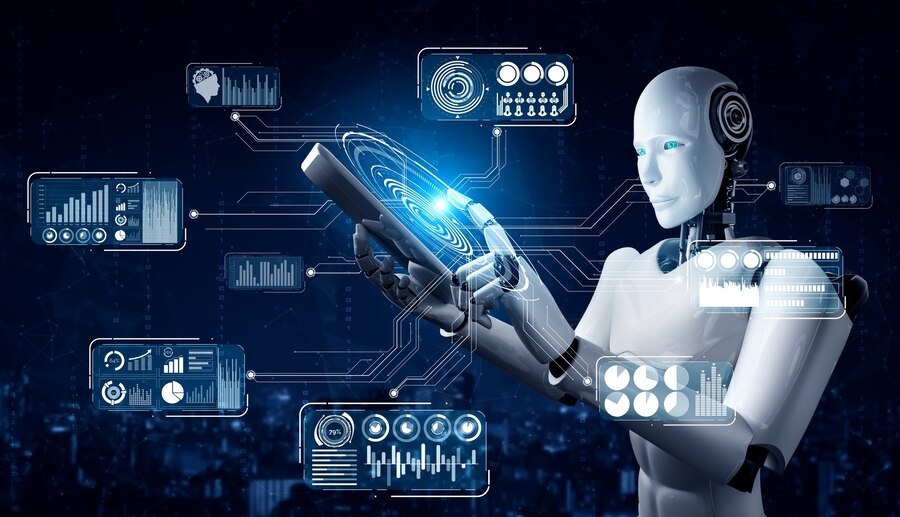
Image
 Automation, once a distant dream of science fiction, is now becoming a reality that is rapidly reshaping industries and propelling us into the future. From manufacturing and transportation to healthcare and customer service, automation is revolutionizing the way we work, live, and interact. In this blog, we will explore the rise of automation, its impact on various industries, and its transformative potential for the future. Understanding Automation: To grasp the significance of automation, we must first understand its essence. Automation refers to the use of technology, such as artificial intelligence (AI), robotics, and machine learning, to perform tasks or processes with minimal human intervention. It aims to streamline operations, enhance efficiency, and reduce human error. Automation in Manufacturing: The manufacturing industry has been at the forefront of automation for decades. With the advent of industrial robots, automated assembly lines, and advanced control systems, pro...

Revolutionizing the World of Robotics: Insights, Innovations, and Advancements

Image
 Robotics has revolutionized the way we perceive technology and has become an essential part of modern society. With advancements in science and technology, the field of robotics has made tremendous progress in recent years and is continuously evolving. From humanoid robots to industrial robots, the scope of robotics is vast and diverse. In this blog, we will discuss the insights, innovations, and advancements that have made the world of robotics so fascinating. Insights: Robotics is a field that involves the design, construction, and operation of robots. Robots can be autonomous or semi-autonomous, and they can be controlled by computers or operated by humans. The field of robotics includes a broad range of applications, including manufacturing, transportation, healthcare, and entertainment. One of the most significant insights into the world of robotics is the potential for robots to improve the quality of life for humans. For example, in healthcare, robots can assist in surgerie...

"Interconnected Innovation: Unleashing the Power of the Internet of Things (IoT)"

Image
 Interconnected Innovation: Unleashing the Power of the Internet of Things (IoT) The Internet of Things (IoT) is revolutionizing the way we live and work by connecting everyday objects to the Internet, enabling them to collect and exchange data and perform tasks autonomously. This paradigm shift in technology has the potential to transform industries, improve efficiency, and enhance our daily lives in ways we could have never imagined before. "Interconnected Innovation: Unleashing the Power of the Internet of Things (IoT)" is a title that encapsulates the transformative impact of IoT and highlights the immense potential it holds for the future. At its core, IoT is about connectivity - connecting devices, sensors, and systems to enable seamless data exchange and communication. The title "Interconnected Innovation" reflects the concept of devices being interconnected and working collaboratively to achieve innovative outcomes. This interconnectedness allows for real-ti...

"5G Technology: Powering the Fourth Industrial Revolution"

Image
 5G Technology: 5G technology is the next generation of mobile networking that promises faster speeds, greater capacity, and lower latency than ever before. It is being touted as a key enabler of the Fourth Industrial Revolution, a new era of technological advancement that is poised to transform virtually every aspect of modern society. In this article, we will explore how 5G technology is powering the Fourth Industrial Revolution and what implications it has for businesses and consumers alike. The Fourth Industrial Revolution, also known as Industry 4.0, is characterized by the convergence of technologies such as the Internet of Things (IoT), artificial intelligence (AI), and robotics. It is transforming traditional manufacturing processes by enabling greater automation and efficiency, as well as creating new business models and opportunities. According to a report by the World Economic Forum, the Fourth Industrial Revolution has the potential to create $3.7 trillion in value by 2...

"The Rise of Intelligent Machines: Exploring the Fascinating World of Artificial Intelligence"

Image
 Exploring the Fascinating World of Artificial Intelligence Artificial Intelligence (AI) is a rapidly advancing field that has the potential to transform the way we live, work, and interact with each other. At its core, AI involves the development of intelligent machines that can perform tasks that typically require human intelligence, such as visual perception, speech recognition, decision-making, and natural language processing. One of the key areas of AI research is machine learning, which involves training algorithms to recognize patterns and make predictions based on large sets of data. This approach has been used to develop a range of AI applications, such as self-driving cars, virtual personal assistants, and medical diagnosis systems. Another important area of AI research is natural language processing, which involves teaching machines to understand and generate human language. This technology is already being used in chatbots, voice assistants, and translation tools, and h...

"Revolutionizing Efficiency: The Power of Robotic Process Automation (RPA)"

Image
Robotic Process Automation (RPA) is a technology that has been revolutionizing efficiency in a number of industries in recent years. RPA involves the use of software robots, or bots, to automate repetitive and rule-based tasks that were previously performed by humans. This technology has the potential to drastically reduce the time and cost required to complete these tasks, freeing up human workers to focus on more complex and strategic work. One of the key benefits of RPA is its ability to improve accuracy and reduce errors. By automating tasks such as data entry or invoice processing, RPA can significantly reduce the number of mistakes that occur due to human error. This can lead to cost savings and improved efficiency for businesses that rely on accurate data and timely processing. RPA is also highly scalable, meaning that it can easily adapt to changes in demand or workload. As businesses grow and expand, they can quickly deploy additional bots to handle increased volumes of work w...